Artificial intelligence has made it possible to generate images in seconds. A few words typed into a prompt box can create landscapes, characters, or entire imaginary worlds.
Because of this speed, many people assume that the prompt is the creative act.
But the most interesting AI art does not begin with prompting.
It begins with an idea.
The Problem With “Prompt First” Thinking
Many beginners approach AI art by typing random prompts and generating images repeatedly until something looks interesting.
While this can produce visually impressive images, the process often becomes about selecting outputs rather than creating ideas.
When prompting comes first, the AI ends up doing most of the thinking.
This is why many AI images look technically polished but lack depth or meaning.
Creativity requires more than description. It requires intention.
How Artists Actually Create
Artists rarely start by describing a finished image.
Instead, they explore.
This process may include:
quick sketches
collecting visual references
experimenting with colour
developing characters or stories
exploring mood and symbolism
Only after these ideas begin to take shape does the artwork evolve.
AI works best when it becomes part of this process.
When creativity comes first, prompting becomes a tool for exploring ideas, not replacing them.
Teaching Children to Think Before Prompting
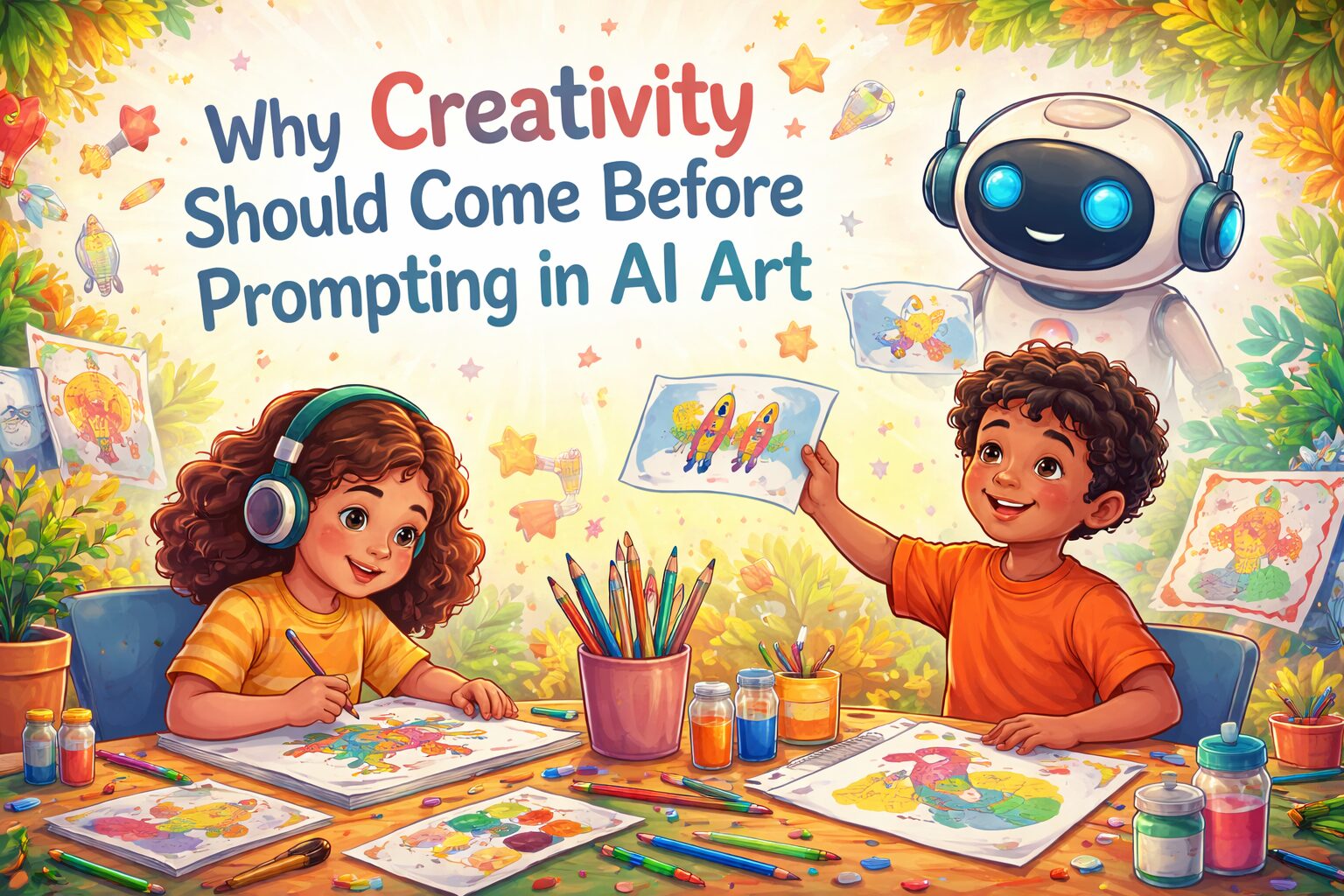
At CSAI workshops we encourage children to begin by creating something themselves.
They might:
draw a character
make a collage
experiment with artistic styles
build a small visual story
Only after this exploration do we introduce AI tools.
When children feed their own drawings and ideas into AI systems, they quickly discover something important:
the quality of the output depends on the quality of the idea.
AI becomes a creative amplifier rather than a shortcut.
Watching the Future Through Children’s Eyes
For many adults, watching children experiment with AI tools is a surprisingly emotional experience.
When many of us were young, our world looked very different.
We played with marbles in the street.
We built imaginary worlds with toys.
We watched science fiction films and dreamed about impossible machines.
We imagined computers that could talk to us.
At the time, it felt like pure fantasy.
And yet today, those childhood science-fiction dreams are becoming real.
Children can now talk to computers, generate images from ideas, and experiment with powerful creative tools that many of us could only imagine when we were young.
Seeing this unfold brings a sense of excitement and hope.
A Bright Creative Future With AI
Artificial intelligence is changing how creative tools work. But creativity itself remains deeply human.
When children learn to use AI with curiosity, imagination, and critical thinking, something important becomes clear.
The future of creativity is not about machines replacing artists.
It is about people discovering new ways to imagine.
Perhaps the most hopeful part of this technological moment is that the next generation is not simply consuming AI.
They are learning how to shape it.
And that may be the most creative opportunity of all.
Lorem ipsum dolor sit amet, consectetur adipiscing elit. Ut elit tellus, luctus nec ullamcorper mattis, pulvinar dapibus leo.