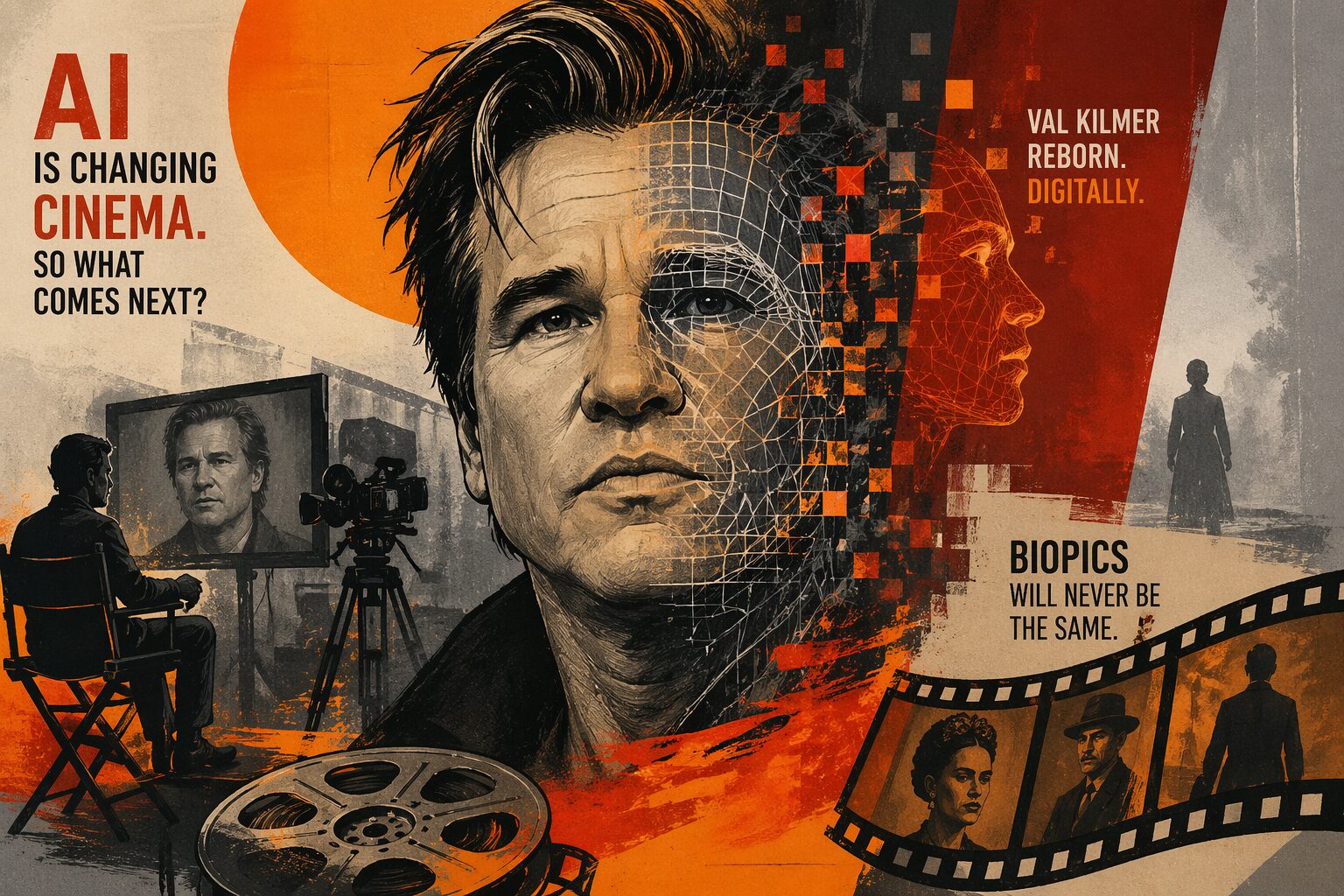
A new film, As Deep as the Grave, brings Val Kilmer back to the screen using AI—long after his death. Not a tribute montage. Not archival clips stitched together. A full performance, reconstructed from voice, image, and past material, with his family’s approval.
It’s a technical breakthrough, yes. But more than that, it’s a conceptual one.
Because once this becomes viable—and it clearly is—you have to ask a simple question:
What happens to the entire film industry when actors no longer need to be physically present?
Especially biographies
This hits biographical films first. And hardest.
For decades, biopics have relied on approximation. You cast someone who can carry the role, study the gestures, get the voice close enough. Sometimes it works beautifully—Salma Hayek playing Frida Kahlo is a good example. It wasn’t imitation; it was interpretation.
But it was still one person standing in for another.
Now that gap can disappear.
You don’t need someone to play Frida Kahlo. You can, in theory, bring Frida Kahlo herself back—her face, her expressions, even her voice reconstructed.
That’s a radical shift.
It removes interpretation from the equation and replaces it with something closer to presence. Or at least, the illusion of it.
And that’s where things get complicated.
Is that better… or just different?
There’s an instinct to say this is more “authentic.” After all, you’re closer to the real person.
But authenticity in cinema has never been about accuracy alone. It’s about interpretation. About what an actor brings to a role—their timing, their sensitivity, the way they filter a life through their own body.
Take that away, and you gain precision.
But you might lose something less measurable.
Friction. Distance. Translation.
The very things that often make performances interesting.
Acting doesn’t disappear—it changes shape
Actors aren’t suddenly obsolete. That’s not how this works.
But their role shifts.
Instead of being the physical vessel of a performance, they may become collaborators in building it. Training AI models on their voice, their gestures, their emotional range. Designing how they are represented, rather than simply performing in real time.
In some cases, they may exist as licensed identities—used across projects, modified, extended.
The performance becomes something that can be edited, revisited, even outlive them.
Which raises a sharper question:
If a performance can be endlessly refined, is it still a performance—or is it a construction?
The real shift: narrative takes control
What this technology really does is expose where the power is moving.
If you can generate any face, any voice, any historical figure, then the focus shifts away from who is performing…
…and onto what is being told.
Narrative becomes the core.
Structure. pacing. emotional design.
The filmmaker isn’t just capturing something anymore. They’re assembling it. Almost like building a system rather than directing a moment.
And that changes the hierarchy of cinema.
The strongest voice in the room is no longer necessarily the actor.
It’s the one shaping the story.
A strange mix of awe and discomfort
There is something undeniably moving about seeing Val Kilmer again in this way. It can feel respectful. Even intimate.
And at the same time, slightly off.
You’re watching someone who isn’t there.
A presence without a present moment.
That tension—between emotional connection and artificial construction—isn’t a flaw. It’s the new condition.
Where this leads
This won’t stay contained.
Biopics will shift first, but the ripple will spread:
- Historical figures may “return” as themselves
- Actors may license their likeness instead of performing traditionally
- Films may construct performances rather than capture them
Cinema moves further away from recording reality…
and closer to generating it.
Final thought
This isn’t the death of acting.
It’s a redistribution.
From body to system.
From performance to design.
And in that shift, one thing becomes very clear:
The real superpower now isn’t acting.
It’s narrative.