For years, the metaverse was sold as the future: a place where we would work, play, socialize, and perhaps even reinvent ourselves through headsets and avatars. It was marketed as inevitable. It was treated as destiny.
Now that fantasy is shrinking in public.
Recent reporting around Meta’s Horizon Worlds suggests a clear retreat from the grand VR-first promise that once defined the company’s vision. What is left is not a triumphant future, but a quieter repositioning toward mobile, accessibility, and lower-friction interaction. The message is hard to miss: the dream changed because reality pushed back.
This matters, especially for artists, curators, technologists, and institutions. Not because Meta failed, but because the failure reveals something important. People do not necessarily want to disappear into virtual worlds. They want meaningful, immediate, shared experiences that respond to them where they already are.
The Problem Was Never Technology Alone
Virtual reality was never just a tool. It arrived wrapped in ideology.
It promised total immersion, but also demanded submission: wear the headset, leave the room, accept the awkwardness, surrender the body to the machine. The pitch was seductive. The experience often felt heavy.
That was always the weakness.
The more the metaverse tried to become a complete replacement for lived experience, the more it revealed its own limits. It confused intensity with relevance. It mistook spectacle for connection.
Horizon Worlds Exposed the Limits of the Fantasy
Meta treated Horizon Worlds as a flagship expression of the metaverse. Now that strategy is being scaled back and redirected. That is not a minor product adjustment. It is an admission, whether stated openly or not, that VR alone did not become the social future it was supposed to be.
What failed was not only a platform. What failed was a style of thinking.
It assumed that people wanted to migrate into synthetic worlds simply because those worlds could be built. But building a world is not the same as making culture. Technical possibility is not the same as emotional necessity.
The Real Shift Is More Interesting
What is replacing that fantasy is, in many ways, more compelling.
The future is looking less like escape and more like response. Less like a sealed virtual universe and more like an intelligent environment. Less headset, more system. Less avatar, more presence.
This is where things get genuinely alive.
We are moving toward spaces that react to voice, gesture, movement, mood, and participation. Environments that do not ask us to leave reality behind, but instead thicken it, distort it, animate it, and answer back.
That is far more interesting than another cartoon plaza full of digital bodies pretending to have a social life.
Why This Matters for Art
Artists should pay close attention here.
The collapse of the VR-first metaverse model opens up a more fertile territory: responsive environments, affective systems, hybrid installations, spatial storytelling, and AI-driven interaction that exists in public, shared, physical space.
This is not a retreat from innovation. It is a correction.
For museums, galleries, science centres, and educational institutions, the appeal is obvious. These works can be collective rather than isolating. They can be visible rather than hidden inside a headset. They can be immediate, embodied, and legible to multiple audiences at once.
That is not a compromise. That is a strength.
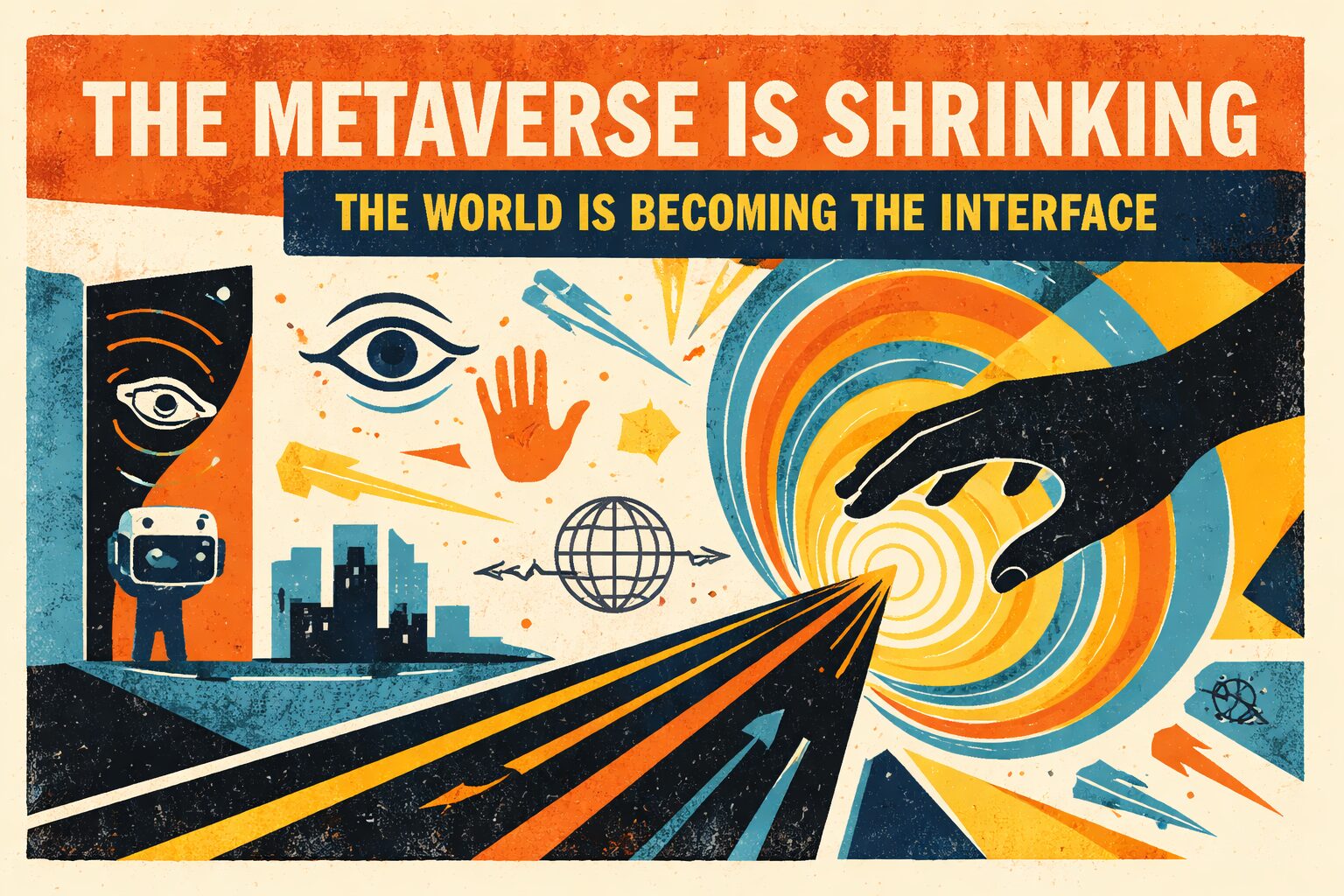
The World Itself Is Becoming the Interface
This is the real turn.
The old model said: enter the machine.
The new model says: the environment is listening.
Walls can respond. Images can mutate. Sound can shift. Light can intensify or collapse. Space itself becomes active. The interface is no longer a screen you face or a headset you wear. It becomes the room, the surface, the installation, the atmosphere.
This is where digital culture starts to recover some intelligence.
For Creative Practice, the Lesson Is Clear
The lesson is not that immersive work is over. It is that the most rigid and overhyped form of it has hit its limit.
What now matters is responsiveness, emotional intelligence, accessibility, and conceptual clarity.
The strongest work ahead will not be the work that simply shows off technology. It will be the work that understands how people feel in relation to systems, images, and space. It will be the work that creates contact rather than just novelty.
That is where artists, researchers, and interdisciplinary studios can do something that big tech often cannot: build experiences with texture, meaning, ambiguity, and actual human depth.
Key Insight
Meta’s retreat from Horizon Worlds is not just the decline of one platform. It is the collapse of a simplistic fantasy about digital life.
The next chapter will belong not to enclosed virtual worlds, but to responsive environments that meet people in shared space and turn interaction into experience.
Conclusion
The metaverse was presented as an inevitability. It turned out to be, at least in its loudest form, a misreading of what people want.
That does not make this moment disappointing. It makes it useful.
When one inflated idea deflates, other possibilities come into view. For those working across art, science, and technology, this is exactly such a moment. The question is no longer how to build a world people can enter. The question is how to make the world they already inhabit become vivid, sensitive, and alive.
That is a far better challenge.