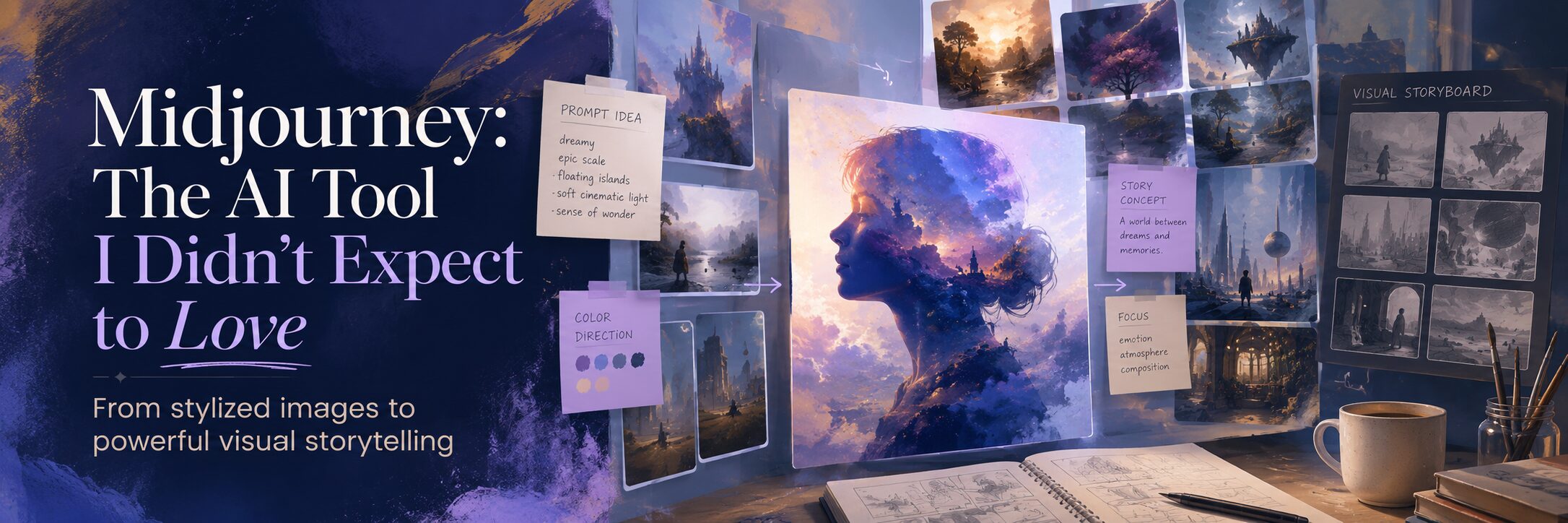
Midjourney: The AI Tool I Didn’t Expect to Love
When I first started experimenting with AI image generation, I went immediately to Stable Diffusion.
At the time, Midjourney simply didn’t appeal to me. I felt that its images were too stylized and too recognizable. There was a certain “Midjourney look” that seemed to appear again and again, and as an artist, I wanted more control over the visual language I was creating.
So, for quite a while, I stayed away from it.
Then something changed in my workflow and I ended up giving Midjourney a proper chance.
And, somewhat unexpectedly, I fell in love with it.
There Is Much More Control Than It First Appears
One of my biggest misconceptions about Midjourney was that it would impose its own aesthetic on my work.
Yes, Midjourney can certainly produce highly polished and stylized images very quickly. But once you start understanding its tools, it becomes clear that you can push it much further.
For me, the breakthrough was working with Moodboards and Style References.
Midjourney’s Moodboards allow you to build a visual direction from a collection of selected images, while Style References allow you to carry elements such as colour, texture, lighting and overall visual atmosphere into new generations.
This changes the process completely.
Instead of asking AI:
“Make me a beautiful image.”
You can start thinking more like a creative director:
What is the colour palette?
What kind of lighting exists in this world?
What textures repeat?
Is the atmosphere cinematic, documentary, surreal, raw, minimal, theatrical or futuristic?
What visual rules hold the whole project together?
Once I started approaching Midjourney in this way, it became much more interesting.
From Single Images to Complete Visual Stories
One of the things I particularly enjoy is using Midjourney to develop an entire visual narrative.
I have managed to create complete storyboards by combining prompts, references and carefully developed Moodboards.
For example, rather than generating one isolated image of a character in a particular environment, I can develop a visual world and then explore that world through different scenes:
a wide establishing shot,
a closer portrait,
an interior,
a dramatic moment,
a detail,
or another stage of the story.
The images don’t have to be identical. What matters is that they feel as though they belong to the same universe.
This is where I think Midjourney becomes particularly powerful for artists, designers and content creators.
It isn’t only an image generator.
It can become a visual development tool.
Midjourney also allows you to create variations of existing generations, use images as part of your prompting process and control how strongly the system interprets its own aesthetic. Its Raw mode, for example, reduces some of Midjourney’s automatic stylistic intervention and gives detailed prompts more influence over the result.
Building Your Own Visual Language
This, for me, is probably the most important point.
The quality of your Midjourney work depends enormously on the preparation you do before generating.
If you simply type a few generic words, you will probably get something visually impressive — but also something generic.
If, however, you research your references, develop a distinctive Moodboard, think carefully about composition and lighting, test your prompts and continue remixing and refining the results, the tool becomes much more powerful.
You begin developing something closer to your own visual system.
And this is where I think people sometimes misunderstand AI image creation.
Prompting is only one part of the process.
Selection is important.
Research is important.
Visual references are important.
Editing is important.
Knowing why one image works and another doesn’t is important.
Essentially, art direction still matters.
AI has not removed that part of the creative process.
The Drawbacks
Of course, Midjourney isn’t perfect.
One consideration is workflow. Midjourney can now be used through both its website and Discord, and most features exist across both environments, although the interfaces and terminology can differ. Personally, the way you access and organise those tools can make quite a difference to the experience.
The other major consideration is privacy.
Midjourney operates largely as an open community. By default, content created publicly can be visible and remixable by other users. If you are developing confidential work, client concepts or projects that you simply do not want visible to others, this is something to take seriously.
Midjourney currently offers Stealth Mode on its Pro and Mega subscription tiers, which allows creations to remain private on the Midjourney website.
For professional users, that additional cost may therefore become part of the decision.
My Verdict
Midjourney surprised me.
I started from the position that it was too stylized and perhaps too restrictive for the kind of work I wanted to make.
I now see it very differently.
Used without much thought, it can certainly produce endless beautiful AI images.
But used deliberately — with research, strong prompts, personal Moodboards, visual references, experimentation and repeated refinement — it becomes a very powerful creative tool.
For content creation in particular, I think its strength is not simply producing one impressive image.
Its real strength is helping you create a coherent visual world.
And once you understand how to build that world, Midjourney becomes something you can return to again and again — not just to generate images, but to develop concepts, storyboards, campaigns and complete visual narratives.
For me, that is where it becomes genuinely useful.